

Most businesses don’t need another strategy deck.
They need someone to quickly determine what matters, what is getting in the way, and what needs to happen next.
That is how I think about the role of a Fractional CEO.
When I step into a business, my first instinct isn’t to start changing things. It is to understand the business well enough to identify where leadership attention will have the greatest impact.
I want to understand the economics. The customers. The constraints. The decisions that have been sitting on the table. And, most importantly, whether the strategy is actually translating into action.
Here are the seven questions I would start with.
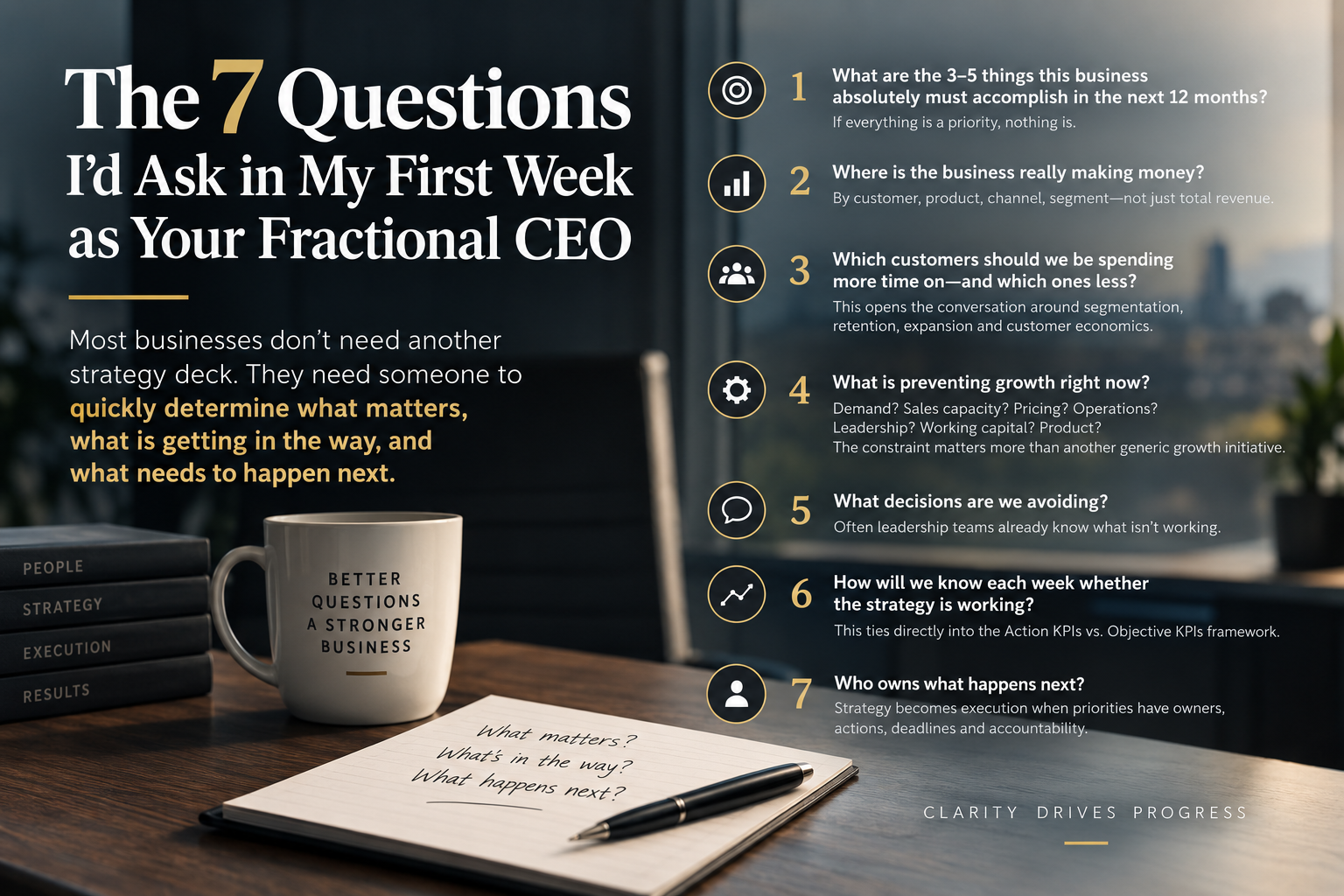
1. What are the 3–5 things this business absolutely must accomplish in the next 12 months?
Ask a leadership team for its priorities and you may get a list of 10, 15 or even 20 initiatives.
That is usually the first problem.
If everything is a priority, nothing is.
The goal is to identify the small number of outcomes that truly matter to the business over the next 12 months.
Maybe the company needs to improve profitability in its core business. Increase retention. Build a more effective sales engine. Fix an operational bottleneck. Successfully integrate an acquisition. Enter a new market.
Whatever they are, leadership should be able to clearly articulate the 3–5 Must-Win Battles that deserve disproportionate attention.
These become the filter for where the organization spends its time, money and leadership capacity.
2. Where is the business really making money?
Revenue alone can hide a lot.
A company may be growing while becoming less profitable. Its largest customers may not be its best customers. A fast-growing product line may carry weak margins. One channel may generate significant revenue while consuming a disproportionate amount of operational resources.
I want to understand profitability by:
Customer
Product or product family
Channel
Segment
Geography, where relevant
The question isn’t simply, “Where are we generating revenue?”
It is: “Where are we creating economic value?”
That distinction can dramatically change where a company chooses to invest.
3. Which customers should we be spending more time on—and which ones less?
Not every customer deserves the same strategy.
Yet many companies effectively treat them that way.
One of the first things I want to understand is what the best customers have in common. Are they more profitable? Do they buy repeatedly? Purchase across multiple product categories? Have greater expansion potential? Require less support? Stay longer?
Then I want to look at the other end of the spectrum.
Which customers are expensive to acquire, difficult to serve, unlikely to repeat, highly price sensitive or simply a poor fit?
Good customer segmentation isn't about ignoring smaller customers.
It is about making deliberate choices about where sales, marketing and leadership attention can create the most value.
Often, meaningful growth is already sitting inside the existing customer base.
4. What is preventing growth right now?
Most businesses want to grow.
That doesn't mean they need another growth initiative.
Before adding something new, I want to understand the constraint.
Is the problem:
Demand?
Sales capacity?
Conversion?
Pricing?
Customer retention?
Operational capacity?
Working capital?
Product?
Leadership bandwidth?
The answer matters.
If demand is strong but operations can't fulfill additional volume, spending more on marketing may make the problem worse.
If leads are plentiful but conversion is weak, generating more leads isn't the answer.
If customer acquisition is working but customers aren't staying, the real growth opportunity may be retention.
The constraint matters more than the generic ambition to grow.
Find the constraint first. Then decide what to do about it.
5. What decisions are we avoiding?
This may be the most important question on the list.
Leadership teams often know where the problems are.
They know the product that isn't working.
They know the role that isn't clearly defined.
They know the customer relationship that consumes too many resources.
They know the pricing model needs to change.
They know the initiative that should probably be stopped.
But knowing and deciding are two different things.
Sometimes an outside CEO perspective is valuable precisely because I don't have years of history attached to those decisions.
I can ask:
What do we already know but haven't acted on?
Frequently, moving the business forward isn't about discovering something new.
It's about finally making the decision everyone has been circling.
6. How will we know each week whether the strategy is working?
A strategy that only gets reviewed quarterly isn't really being managed.
I want to know what leadership should be watching every week.
And this is where I distinguish between two types of KPIs.
Objective KPIs tell us whether we are getting the result we want.
Revenue. Gross margin. EBITDA. Retention. Conversion. Average order value.
They are critical, but many are lagging indicators.
Action KPIs tell us whether we are doing the things likely to produce those results.
Customer meetings. Proposals sent. Dormant accounts contacted. Pricing reviews completed. Operational improvements implemented. Strategic accounts with active growth plans.
You need both.
If an Objective KPI isn't moving, the Action KPIs help us understand whether the strategy isn't working—or whether we simply aren't executing it.
That makes the weekly management conversation very different.
Instead of:
“Why didn't we hit the number?”
We can ask:
“Are we doing the things we agreed would move the number?”
7. Who owns what happens next?
This is where strategy either becomes real or dies.
Every important priority needs:
An owner.
Specific actions.
Deadlines.
Measures of success.
A regular accountability cadence.
“Sales needs to improve retention” isn't an action plan.
“Sarah owns increasing retention in our top customer segment from X to Y, supported by these four initiatives, with these weekly Action KPIs and monthly Objective KPIs” is much closer to one.
There should be very little ambiguity about who is responsible for moving each Must-Win Battle forward.
Because strategy without ownership is just intention.
The Fractional CEO Role Isn't to Create More Strategy
It is to help the organization focus, decide and execute.
In many lower middle-market businesses, there is already a tremendous amount of knowledge inside the company. The leadership team knows the customers. They understand the market. They know the operational realities.
What is often missing isn't intelligence or ambition.
It's clarity.
What matters most?
What is actually driving economic value?
What is standing in the way?
What decisions need to be made?
What actions happen next?
How will we measure them?
And who owns the result?
Those are the conversations I would want to have in my first week.
Not because seven questions can tell you everything about a business.
But because the answers can tell you where to start.
And sometimes that is exactly what a business needs: not another strategy deck, but an experienced operator who can help turn strategy into execution.
