

Most organizations have KPIs.
The bigger question is whether they have the right KPIs.
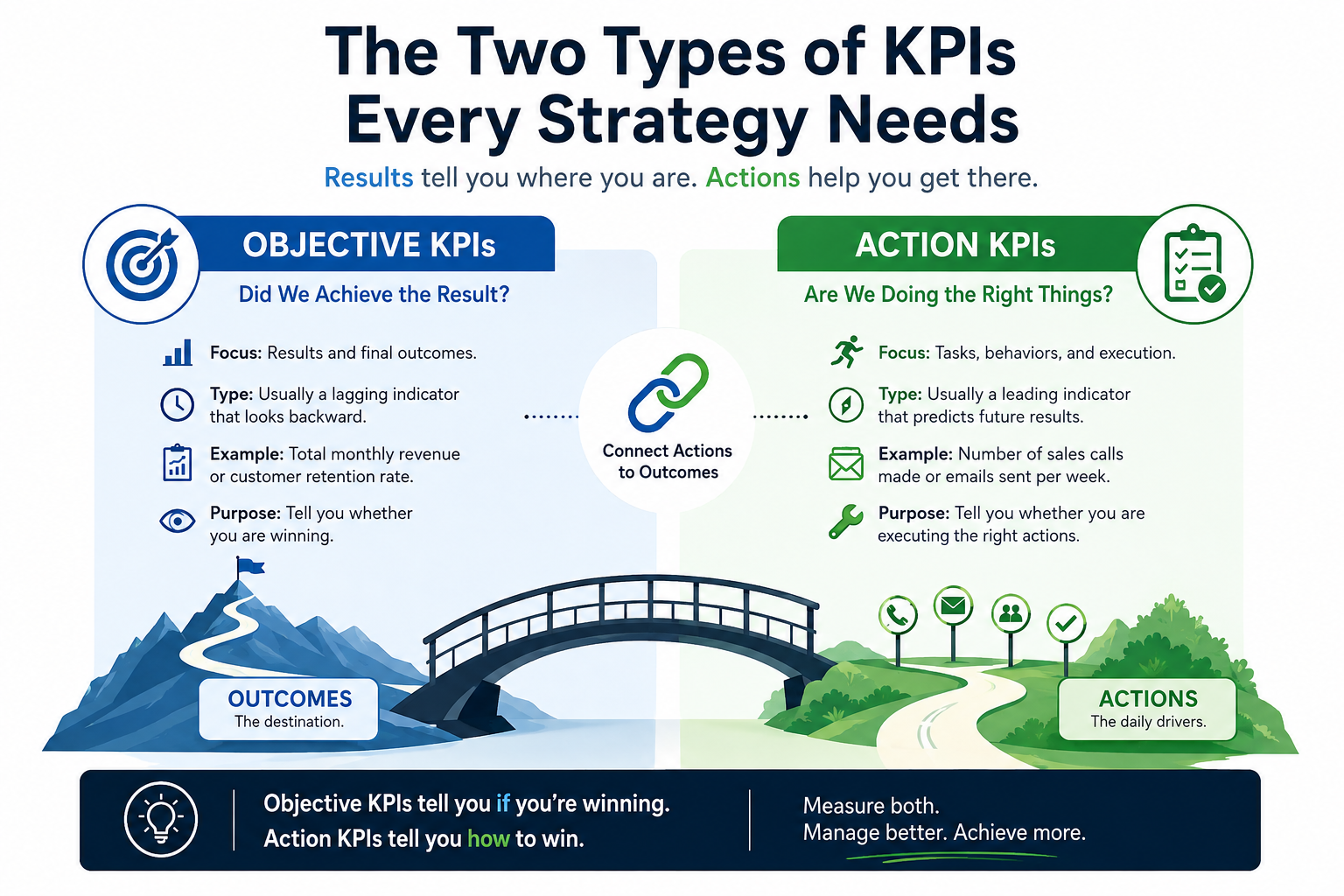
One of the most useful ways to think about measurement is to separate KPIs into two categories:
Objective KPIs tell you whether you are winning.
Action KPIs tell you whether you are doing the things likely to help you win.
You need both.
If you only measure outcomes, you may discover a problem after it has already happened. If you only measure activity, your team can be very busy without actually producing meaningful results.
The strongest measurement systems connect the two.
Objective KPIs: Did We Achieve the Result?
Objective KPIs measure the business outcome you are trying to create.
They are generally lagging indicators because they tell you what has already happened.
Examples might include:
Revenue growth
Gross margin
Customer retention rate
New customer revenue
EBITDA
Employee retention
Customer satisfaction
Waste diversion rate
On-time delivery rate
If your strategic priority is to increase customer retention, your Objective KPI might be:
Increase customer retention from 70% to 78%.
That is the result.
It gives the organization a clear definition of success.
But there is a problem with relying on Objective KPIs alone.
By the time you see the number, much of the work that produced it has already happened.
Knowing that customer retention declined last quarter is important. But it doesn't necessarily tell you what to do differently tomorrow.
That's where Action KPIs become important.
Action KPIs: Are We Doing the Work That Should Produce the Result?
Action KPIs measure the activities, behaviors and execution that should drive the desired outcome.
They are often leading indicators because they give you an earlier indication of whether the organization is doing the things necessary to achieve its objective.
For a customer retention objective, Action KPIs might include:
Percentage of key accounts receiving quarterly business reviews
Number of proactive customer outreach conversations
Percentage of customers contacted within 30 days of purchase
Number of dormant customers contacted each month
Percentage of customer issues resolved within 24 hours
These metrics don't tell you whether you have achieved your ultimate goal.
They tell you whether you are executing the strategy designed to achieve it.
The Difference Is Simple
Think about it this way:
Objective KPI Action KPI Question
Did we get the result? Are we doing the right things?FocusOutcomesExecutionIndicatorUsually laggingUsually leadingTimingLooks backwardHelps predict forwardExampleCustomer retention rate% of key customers proactively contacted
Both are important, but they serve very different purposes.
Connect the Action to the Outcome
The most useful KPI systems create a visible connection between strategy, actions and results.
For example:
Strategic Priority: Grow our highest-potential customer accounts
Objective: Increase revenue from strategic accounts by 15%
Objective KPIs:
Strategic account revenue
Revenue growth per account
Customer retention
Average order value
Action KPIs:
Strategic account meetings completed
Account plans completed
Opportunities identified within existing accounts
Proposals delivered
Follow-up activities completed
Now the management conversation becomes much more useful.
Instead of simply asking:
"Did revenue grow?"
you can also ask:
"Are we consistently doing the things we believe will cause revenue to grow?"
That distinction changes how teams manage performance.
Don't Confuse Activity With Progress
There is also an important warning when using Action KPIs.
Activity isn't automatically valuable.
A salesperson can make 100 calls a week and generate no meaningful opportunities. A marketing team can publish 20 pieces of content without generating a single qualified lead. A leadership team can hold weekly meetings without making important decisions.
The goal isn't to measure everything people do.
The goal is to identify the relatively small number of actions that have a meaningful relationship with the desired result.
A good Action KPI should answer:
If we consistently improve this activity, do we have a reasonable reason to believe the Objective KPI will improve?
If the answer is no, it probably isn't a KPI. It's simply a task or activity.
Start With the Objective, Not the KPI
One of the most common mistakes organizations make is starting by asking:
"What should our KPIs be?"
Start one step earlier.
Ask:
What are we trying to accomplish?
Then work backward.
A simple sequence is:
Strategic Priority → Objective → Objective KPI → Actions → Action KPIs
For example:
Strategic Priority: Improve profitability
Objective: Increase gross margin
Objective KPI: Gross margin percentage
Key Actions: Review pricing, reduce discounting, renegotiate vendor costs, optimize shipping
Action KPIs: Percentage of SKUs reviewed for pricing, discount rate, vendor cost reviews completed, percentage of shipments using optimized freight methods
The Objective KPI defines the destination.
The Action KPIs help you manage the journey.
Use KPIs to Run the Business, Not Just Report on It
This is where KPI systems often fall short.
Organizations build dashboards filled with numbers that leadership reviews monthly or quarterly.
But measurement should do more than tell you what happened.
It should help determine what happens next.
When an Objective KPI is off track, look at the corresponding Action KPIs.
If the actions aren't happening, you may have an execution problem.
If the actions are happening but the objective isn't improving, you may have a strategy problem. The actions you believed would produce the result may not actually be the right ones.
That creates a much more productive management conversation:
Are we getting the result?
Are we executing the actions?
Are those actions actually producing the result we expected?
A Better KPI Scorecard
For each major strategic priority, build a simple scorecard containing:
The Objective
What specifically are we trying to accomplish?
Objective KPIs
How will we know whether we achieved it?
Action KPIs
What critical activities should drive that outcome?
Target
What level of performance are we aiming for?
Owner
Who is accountable for moving the metric?
Review Cadence
How frequently should we evaluate progress?
Not every KPI needs to be reviewed at the same frequency. Action KPIs may make sense to review weekly, while Objective KPIs may be more meaningful monthly or quarterly.
The Goal Isn't More KPIs
A KPI dashboard with 50 metrics isn't necessarily better than one with 10.
In fact, it may be worse.
The purpose of KPIs is to create focus, visibility and accountability around the things that matter most.
For every strategic objective, identify a small number of measures that answer two questions:
1. Are we getting the result we want?
Those are your Objective KPIs.
2. Are we consistently doing the things that should create that result?
Those are your Action KPIs.
When you connect the two, KPIs stop being numbers on a dashboard.
They become a management system for turning strategy into execution — and execution into measurable results.
